Showing posts with label trading secrets. Show all posts

Gold, Copper Prices Retreat amid Tight Races in Geogia's Senate Runoff Election


Gold costs eradicated before gains and tumbled from 8-week highs as the Georgia Senate overflows ran into right races in Asia-Pacific noontime exchanging. Essentially, copper costs endured a minor pullback subsequent to hitting a 7-year high on Tuesday, sponsored by more grounded US ISM Manufacturing PMI readings and strong interest from China.

The US Dollar record bounced back from a two-and-half year low as Democratic leads in the two races at first limited, hosing the possibility for a Democratic scope that may sanction President-elect Joe Biden's authoritative needs including financial and framework spending. Vulnerabilities encompassing the spillover political decision results made a lot of vulnerability that markets will in general abhorrence, bringing about a wide 'hazard off' estimation and elevated instability.

In the medium term, notwithstanding, political decision results may again end up being a momentary impetus for valuable and base metal costs in the midst of a repetitive recuperation in worldwide interest into 2021. This may support a medium-to long haul rally in base metal costs, including copper, nickel and iron mineral. Buying supervisors files demonstrated proceeds with extension in world's biggest economies including the US, EU, China and the most piece of the ASEAN (Association of Southeast Asian Nations) as appeared in the diagram beneath. The US ISM Manufacturing perusing came in at 60.7 versus figure of 56.6, denoting its most elevated perusing seen since August 2018.

Gold, Copper Prices Retreat amid Tight Races in Geogia's Senate Runoff Election 


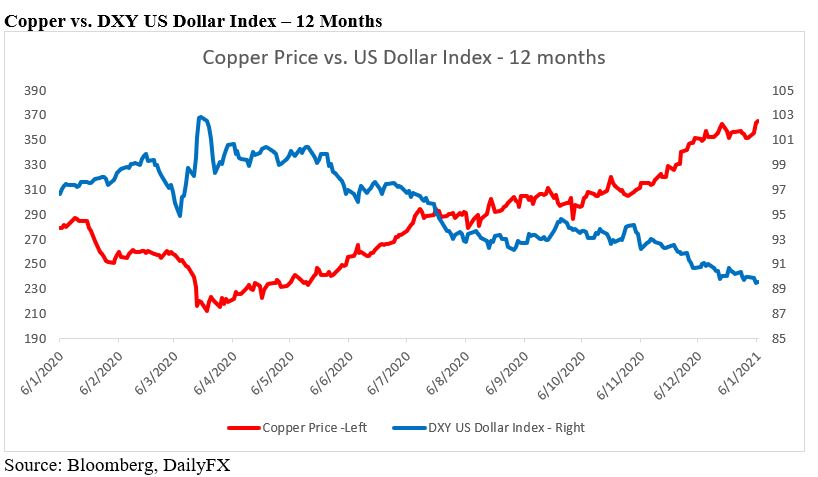
Base metal costs are touchy to the development of the US Dollar, with copper, nickel and iron minerals tending to move in inverse to the Greenback. Like gold, copper costs and the DXY US Dollar Index truly display a negative relationship, with a connection coefficient of - 0.95 in the course of recent months (diagram underneath). The ware connected Australian Dollar has demonstrated solid positive relationship with metal and mineral fuel costs as they represent an enormous segment of Australia's complete fares.

CME Copper vs. DXY US Dollar Index – 12 Months
Gold, Copper Prices Retreat amid Tight Races in Geogia's Senate Runoff Election


Gold prices have likely broken above a “Descending Channel” and entered into a bullish channel (chart below). Prices have formed consecutive higher highs and lows in December– an encouraging pattern that points to a potential medium-term trend reversal. Piercing through a key chart resistance of US$ 1,910 (the 61.8% Fibonacci retracement) this week has likely opened the door for further upside potential with an eye on US$ 1,940 (50% Fibonacci retracement) and then US$ 1,973 (38.2% retracement).

Gold Price – Daily Chart

The LME copper prices appear to be riding an ascending trend with the 20-, 50- and 100-Day Simple Moving Averaeg (SMA) lines lining up higher. Prices are hitting the uppper Bollinger Band and thus are susceptible to a technical correction. A firm break above the immediate 76.4% Fibonacci exension at 7,955 may open the room for further upside potential with an eye on 8,488 (100% extension). A pullback from here may lead to a test of 7,839 (20-Day SMA) for support.

Copper Price – Daily Chart

Gold, Copper Prices Retreat amid Tight Races in Geogia's Senate Runoff Election


To Get Regular Market Updates and Signals, Join Me!

Forex Outlook for EURUSD


EUR/USD is off the highs, trading around 1.2250. The USD attempts a comeback amid global Coronavirus concerns and disappointing Chinese PMI. The focus this week remains on German, US data, and Georgia Senate elections. The EUR/USD pair eased on profit-taking after hitting a year’s high at 1.2309. The daily chart shows that the latest decline seems corrective, as the pair remains above all of its moving averages, which maintain their bullish bias. Technical indicators eased within positive levels, correcting overbought conditions. In the near-term, and according to the 4-hour chart, however, the pair broke below its 20 SMA, which is now flat at around 1.2270. 


Join My Whatsapp Group:  https://bit.ly/38V0OzP


Can I Really Make Money Trading Forex?

The short answer to that burning question is: ‘Yes, you certainly can make money trading Forex’. But you didn’t come here just for the short answer, did you?

A more comprehensive answer would be: ‘Yes, it simply wouldn’t exist if people didn’t make money from it. That said, the percentage of people who make money is small and there are a number of reasons why’.

Better still, do you want to know what those reasons are? Well, lucky you, because we’ve summarized the most common traps beginners fall into that and how they can avoid them.


Starting with an insufficient amount of knowledge

A lot of beginners are interested in Forex trading for the wrong reasons. They falsely perceive Forex trading as a get rich scheme. An easy way to make money that requires minimal effort. Quite frankly, this a myth. If this is your perception of what Forex trading is, you are certainly not ready to start trading. Trading at this point will likely lead you down one of two roads. Either you’ll lose a considerable amount of money on bad trades or you’ll end up very disappointed by your lack of success and likely quit trading altogether. The first thing you should do is get a currency trading education. Without an education in Forex, how do you suppose to utilise any of that information?
 

Not understanding risk management

Only a small portion of retail Forex traders actually make a profit. Depending on where you look, a lot of retail traders lose money. Traders should know how much they are willing to lose on a trade. They need to set goals: when they should enter a trade; when to take profit; when to get out before things get worse. They should stick to these goals and shouldn’t change their plans at the last minute on the possibility of making more money if the market moves quicker than expected. Of course, the market may shoot up immediately after you take profit and you may miss out on a higher gain. But you need to accept this and move on.

Chasing losses

This is when a trader makes a loss and then tries to make the money back by making further trades, sometimes increasing in size. Why is this a horribly bad idea? Because these trades are motivated by a desperate feeling to regain what you lost instead of any insight into where the market might be going. Of course, it is very natural to react in this way. But the thing about trading is that it shouldn’t be reactive, it should be orchestrated with set goals, goals based on good research. The most successful Forex traders won’t waste their time in this way. Instead, they need to be able to accept their losses, learn from their mistakes, move on and then look to the next opportunity to make a profit.

Not having a plan

Traders who are highly organised and able to plan out their day and even their week tend to be more capable of avoiding risks and putting their emotions to one side. Having a plan also allows you to try new things and develop an effective strategy. Devising a strategy that works for your trading style is one of the most important things you can do. But a plan doesn’t just involve setting up your goals, as we mentioned above. It also means saving time to learn new things. Forex Market  should be looked upon as a never-ending process. The minute you stop teaching yourself new things about the Forex market you are leaving yourself exposed to making mistakes.

Forex trading is a SKILL that takes TIME to learn. Skilled traders can and do make money in this field. However, like any other occupation or career, success doesn’t just happen overnight.

If you are looking to make real money through Forex Trading or have incurred a loss, Connect with me at: 

Whatsapp: wa.me/918815110728 

What is “Position Sizing” and Why Is It Important?

Proper position sizing means setting the correct amount of units to buy or sell an asset. In other words, it involves finding the position s...